The Ceiling Height Formula I Actually Test on Site
This isn’t theory. This is a number I’ve verified on real projects, over and over.
The formula: (number of levels x 1.4 meters) + 0.2 meters (top frame safety clearance) + 0.5 meters (mandatory fire sprinkler buffer).
Working with playground equipment manufacturers who understand this formula and can apply it to your specific site before you sign anything is the difference between a layout that fits and one that doesn’t.
Want a standard two-level structure? Let’s do the actual math: (2 x 1.4m) + 0.2m + 0.5m = 3.5 meters. That means your warehouse needs an absolute minimum clear ceiling height of 3.5 meters to legally build a two-level play area. If your warehouse only has 3 meters, you cannot build a two-level structure. That’s just physics.
Before you sign any commercial lease, run this formula. Whether the space you’re looking at can accommodate your planned project isn’t negotiable once the steel is cut.
One important note: 1.4 meters is the height we use most commonly for each level. But if your ceiling height allows it, each level’s height is freely adjustable. In facilities with generous clear height, we’ve made levels at 1.6-1.8 meters, giving older children enough headroom to sit and play comfortably in the upper zones. The formula gives you the minimum – when site conditions permit, we optimize each level for actual comfort rather than the minimum.
Small or Low Spaces – Turning Constraints Into a Positioning Advantage
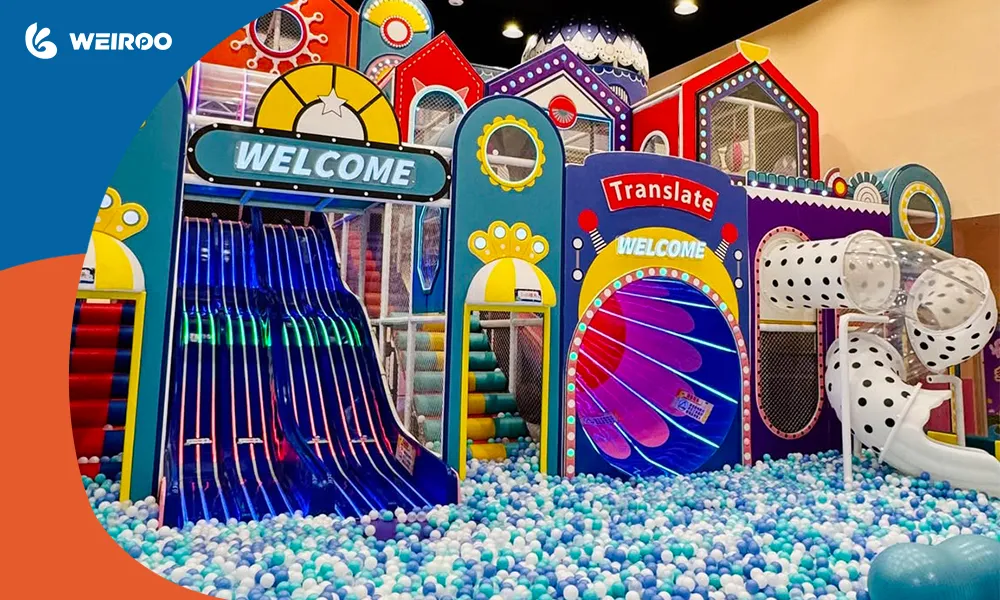
We see this situation regularly. When both area and height are constrained, we work with the client to shift the target age group downward.
The specific approach: adjust the play framework height to match the available space, and select equipment designed for younger age groups. This isn’t settling for second best – it’s a positioning strategy. The disadvantage of a small site not being able to host large slides or complex multi-level structures becomes a competitive differentiator when your target is young families with infants and toddlers.
Parents of babies and toddlers have a real problem finding suitable places to take their children. A small, well-designed soft play area specifically for 0-3 year olds faces very little direct competition in many markets, and the demand is real and frequent. In some locations, a compact 100-150 sqm infant zone outperforms much larger general-play facilities on revenue per square meter.
Columns Are the Most Underestimated Site Killer
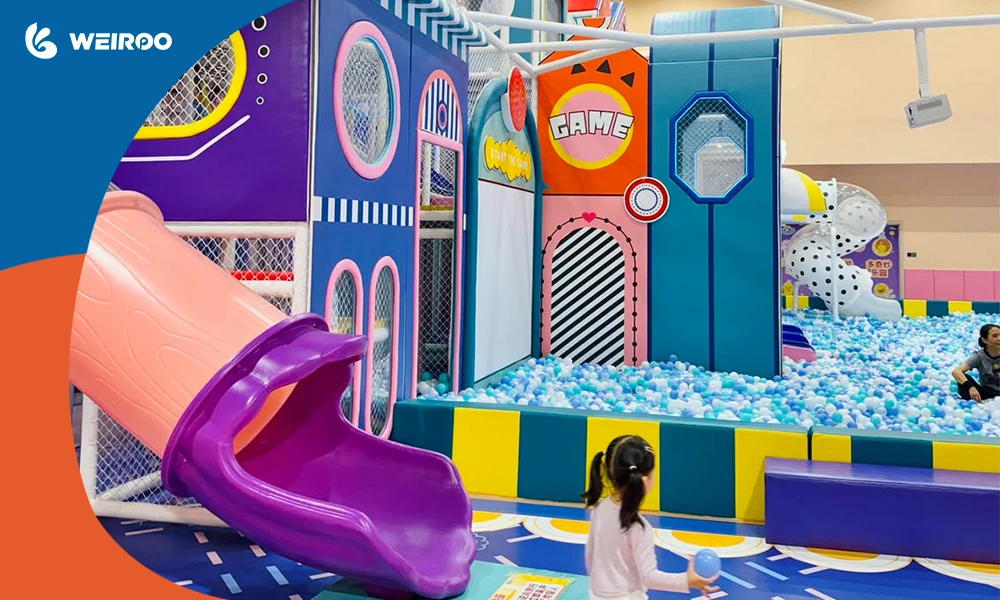
Columns destroy customer experience and destroy your layout.
Imagine you’ve designed a massive, beautiful, open-plan ball pit. Now imagine a large, ugly concrete column sitting in the middle of the children’s play area. It looks bad. More importantly, it breaks the sight lines for parents – they can no longer monitor all areas of the play zone from a single seated position. A parent trying to watch a toddler near the ball pit who also needs to keep an eye on an older child in the climbing zone can’t do both from one seat if a column is blocking their view.
For safety reasons, our installation team has to wrap every single column with thick custom foam padding to prevent children from hitting their heads while running. This cost is additive, and it was entirely avoidable if the column problem had been addressed during site selection rather than discovered during installation. In some markets, column wrapping is also subject to specific fire and safety material requirements – another variable that adds cost and lead time that site selection could have avoided entirely.
This is why, before any engineer starts designing a single piece of steel, I always ask clients to send me clear photos of the exposed ceiling along with dimensions. The renderings you see and what actually gets built can be very different things once you account for the pipes, ducts, and structural elements you didn’t see in the finished space.
Floor Load Capacity Isn’t the Problem – Floor Levelness Is
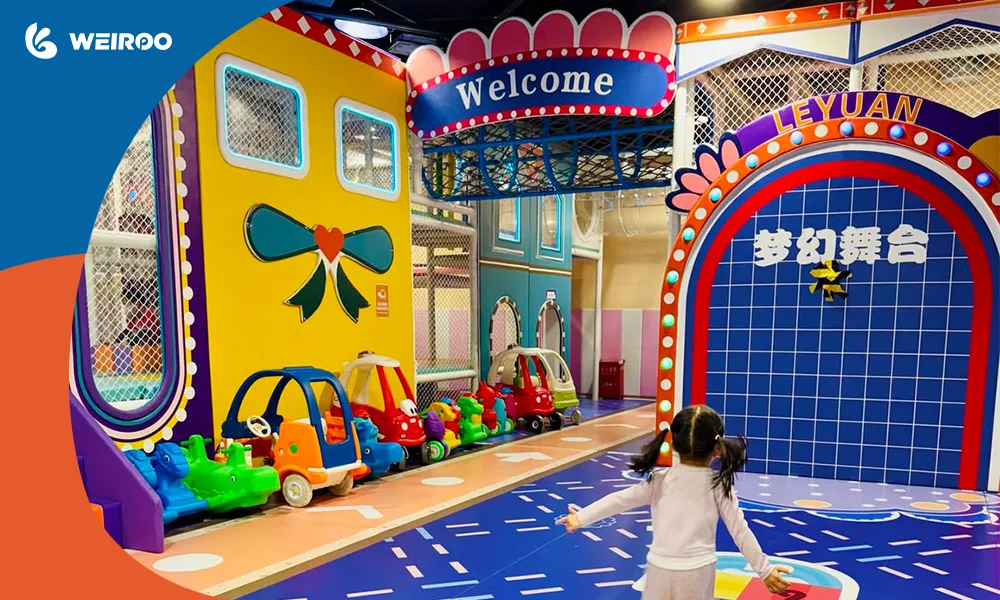
Our equipment has no special requirements for floor load capacity. You don’t need reinforcement, no special treatments, just a level surface. This applies equally to upper floors in commercial buildings and ground-level warehouses.
But levelness is something that’s consistently underestimated. An unlevel floor, or a self-leveling compound that hasn’t fully cured, directly affects our installation precision and long-term structural safety. Running a level across the floor before you sign the site agreement takes five minutes and can save you significant problems after installation begins.
You Think You’ve Gained Headroom. You Haven’t.
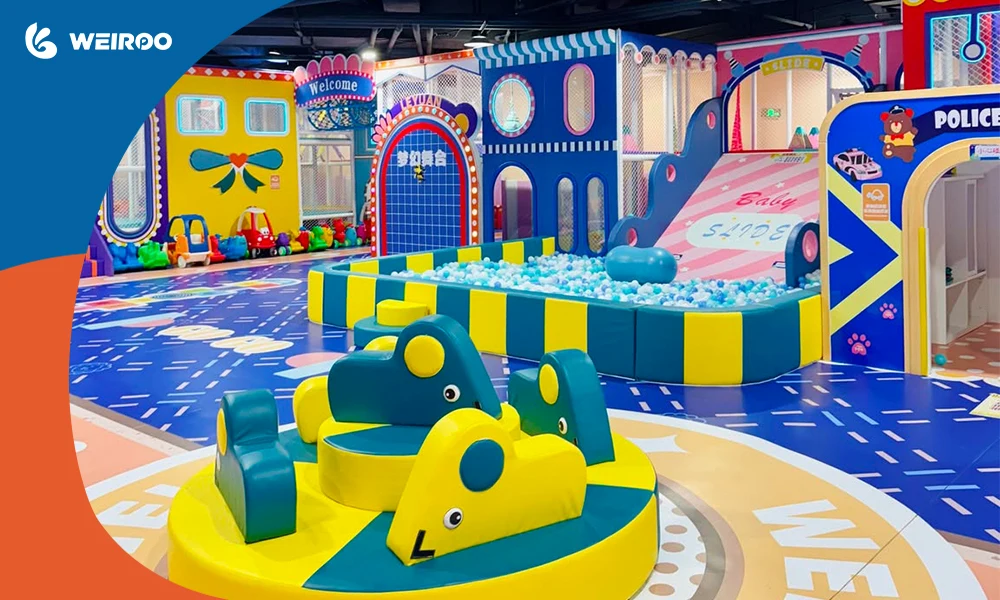
This is the most common cognitive error I see, and the people making it aren’t amateurs – they’re experienced operators.
They look at old ceiling tiles, decide to tear them out, and assume they’ve immediately gained 2 meters of clearance. They haven’t. The large HVAC ducts and fire sprinkler pipes are still hanging there. When you strip out the ceiling tiles, you’ve only exposed the things that were always there, always occupying that vertical space. The clearance you thought you were getting is the clearance between the old ceiling tiles and the pipes – not the clearance between your floor and the structural ceiling.
Remember: fire inspectors measure from the lowest hanging pipe to the floor. Not from the flat concrete roof to the floor. They measure your actual usable minimum clearance, not the number you’re imagining based on the finished ceiling height.
Before our engineers design a single piece of steel, I always ask clients to send me clear photos of the exposed ceiling with dimensions. Don’t show me the space you imagined. Show me the space you actually have. I’ve had clients send me photos of exposed ceilings that showed 6 meters of structural height, and then a closer look revealed that the fire sprinkler main ran across the entire ceiling at 3.8 meters – which sounds workable until you account for the bracketry and sprinkler heads that hang below the pipe itself, reducing the actual clear height below what a two-level frame needs, and moving the main requires fire department approval and a licensed contractor.
Four Things to Confirm Before You Contact Any Equipment Supplier
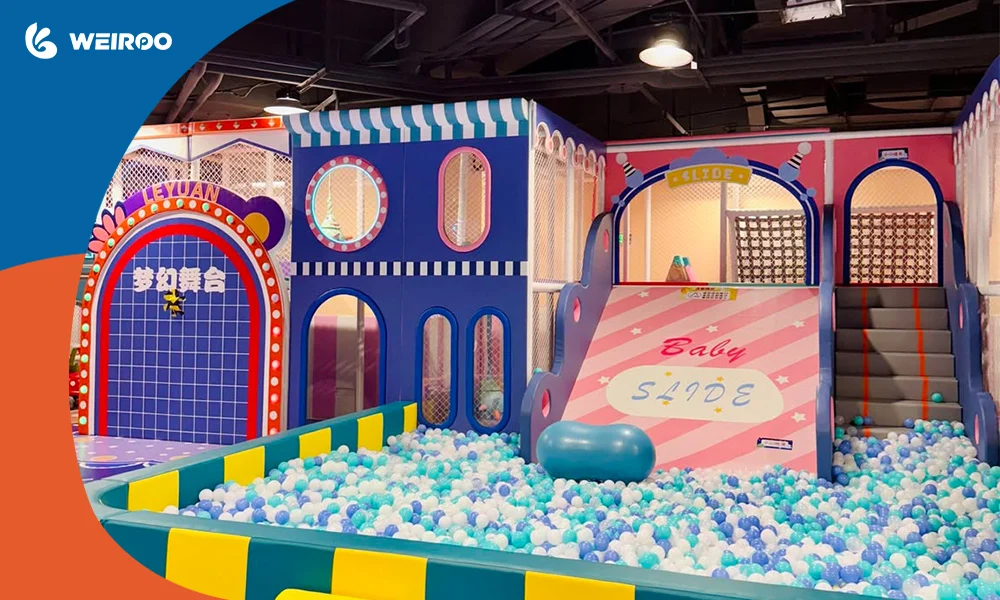
Before you reach out to any playground equipment supplier, confirm these four things:
What is your actual clear ceiling height? Run the formula (levels x 1.4m + 0.7m fixed buffer) to determine how many levels and which age groups you can realistically accommodate. If your clear height is under 3 meters, don’t plan a two-level structure. If it’s under 3.5 meters, two levels are marginal at best.
Where are your columns, exactly? Photograph them, measure them, mark them on a floor plan. Every column’s position directly affects the layout – and some positions that look manageable in a rough sketch turn out to split an entire functional zone’s traffic flow when the actual equipment is laid on top. A column in the wrong place can force you to abandon an entire zone concept you had planned.
How level is your floor? Any local high or low spots? Any coating that’s been applied but isn’t truly level? These become the things that undermine your opening date when installation precision can’t be achieved on an uneven surface. If you’re in an upper floor space, check whether the floor has any slope toward the edges – even a slight slope affects long run components.
Have you photographed the exposed ceiling? Send it to your supplier before you sign. Let them tell you what they see before the contract is signed, not after the equipment is already on a ship. The supplier who confirms your layout without having seen the exposed ceiling is learning on your timeline – and paying for that education in delays and redesign costs.
Frequently Asked Questions
What is the actual minimum ceiling height for an indoor playground?
For a two-level structure, the formula (2 x 1.4m + 0.7m) gives approximately 3.5 meters minimum clear height. Note that this is clear height to the lowest obstruction – not from the floor to the concrete ceiling, but to whichever pipe, duct, or structural element hangs lowest. If your site has exposed ductwork, measure to the lowest point, not to the roof itself. When you’re evaluating a space before signing a lease, always measure to the lowest point of the lowest hanging service. That’s the number your layout has to work with. If you’re unsure whether your space can accommodate the project you have in mind, share the exposed ceiling photo before you commit to anything. And before you sign anything, make sure you’ve reviewed the full indoor playground business plan to understand what you’re building toward.
Can a small space still work as an indoor playground?
Yes – but the positioning has to be precise. Sites under 200 sqm should target families with children aged 0-5, with equipment focused on soft play and low structures. This positioning faces very little direct competition in many markets, and the demand from parents of infants and toddlers is consistent and high-frequency. A compact infant zone in a well-positioned small space often outperforms much larger general-play facilities on revenue per square meter. When you’re ready to explore options for your specific site, working with a commercial indoor playground equipment supplier who can show you real site fit examples from your target market is the practical next step.
Do columns affect equipment selection?
Absolutely. Columns affect traffic flow, break parent sight lines across the play area, complicate fire safety evacuation planning, and add custom wrapping and foam padding costs to the installation. Every column position needs to be reported to your supplier during the design phase, not discovered during installation. When you’re in the site evaluation phase, documenting column positions early and sharing them with indoor play area suppliers before they start layouts saves expensive redesigns later.
Can upper floors in commercial buildings support indoor playground equipment?
Yes. Our equipment has no special floor load requirements for standard commercial building floors – ordinary commercial floor load capacity is sufficient. The critical requirement is floor levelness, not structural capacity. Any significant uneveness needs to be corrected with self-leveling compound before installation begins, and the compound must be fully cured before our teams begin precision anchoring. If you’re placing equipment on an upper floor, also check whether the building’s fire safety certificate for that floor covers the occupancy type you’re planning – some jurisdictions require separate certification for entertainment floor loads above certain levels.
After I remove the ceiling tiles, how does the fire inspector actually measure clearance?
Fire inspectors measure from the lowest hanging obstruction to the floor – not from the concrete roof to the floor. The HVAC ducts, fire sprinkler pipes, and any other services hanging from the structure all count. When you strip out old ceiling tiles and expose the ductwork and pipes above, you’re not gaining the full difference between the old ceiling height and the structural ceiling – you’re gaining the difference between those pipes and the old ceiling. Before you sign a lease on a space with old ceilings, go in with a tape measure and measure from the floor to the lowest hanging point yourself. That’s your real number. If the numbers work out, our guide to importing playground equipment from China walks through the rest of what you need to confirm before you commit.