If you’re budgeting for your first independent trampoline park of about 1,500 square meters (16,146 square feet), plan on roughly $500,000 to $600,000 in total. Start with the equipment: our quick estimate is about $120 per square meter of floor area, or about $180,000 for a park this size. The rule of thumb we use is that the equipment will take about a third of the total budget for a park this size. In a small park of a few hundred square meters, it is often more than half.
Use that as a starting point, not a quote. You get the firm equipment price after the final design rendering of your park, and some projects come out higher. Everything else depends on the building, the location and how long you will be paying rent before opening day.
Franchise parks operate on a different scale. The disclosure documents from three franchise brands put the total initial investment at about $2.3 million to $7.9 million. Those figures cover much larger buildings and formats, which we look at further down.
Weiroo makes trampoline park equipment at our own factory in Zhejiang, China. We have also equipped parks in Spain, Romania, Chile, Guatemala, Australia, the United States and India (see the projects). This guide follows the costs in the order you are likely to meet them and flags the ones that are most often missed.
Equipment Cost by Park Size
As of October 2026, our quick estimate for trampoline park equipment is about $120 per square meter of floor area, FOB. In plain terms, FOB covers the equipment through loading at the port in China. Freight, import duty and installation are extra.
Here is how that estimate works out for some common park sizes. A first independent trampoline park is commonly 1,000 to 2,000 square meters (10,764 to 21,528 square feet) of floor area.
| Floor area | Quick estimate for the equipment (FOB) |
|---|---|
| 300 square meters (3,229 square feet) | About $36,000 |
| 1,000 square meters (10,764 square feet) | About $120,000 |
| 1,500 square meters (16,146 square feet) | About $180,000 |
| 2,000 square meters (21,528 square feet) | About $240,000 |
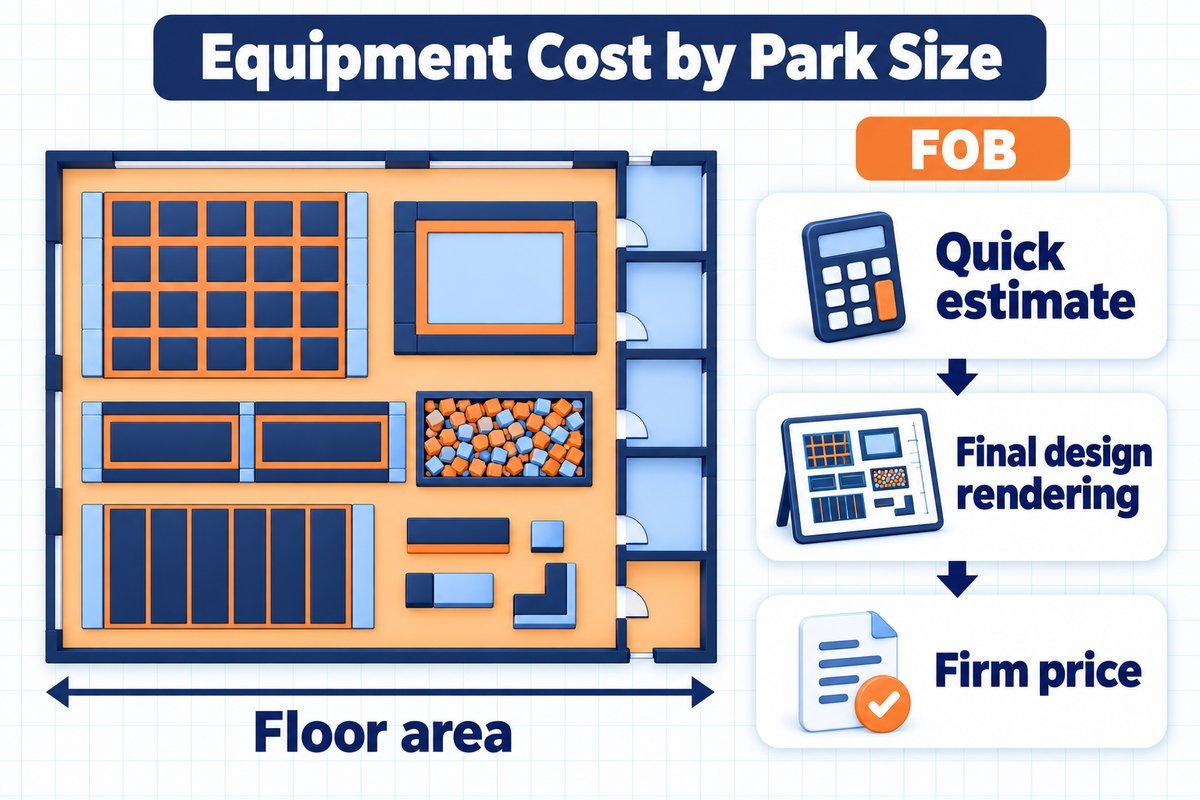
The quick estimate is there to help you budget. We give a firm price once the final design rendering is done, because the zones you choose, the clear height of the building and the column positions all affect what must be built. A ninja course or climbing wall, for example, needs more structure than a flat main court. Some projects come out higher than the quick estimate.
This figure differs from many prices you will see online in two ways. It is per square meter of the whole floor area, rather than per square meter of jumping surface, and it is a factory price at the port of shipment, rather than a delivered price. Check those two points first when comparing it with another supplier’s figure.
For the zones we build and how we deliver them, see our trampoline park equipment.
Shipping, Customs and Installation: The Costs Most Often Left Out
Freight, import duty and installation are the costs first-time buyers most often miss. A factory price such as our FOB estimate does not include them, and the bills come from different people at different points in the project.
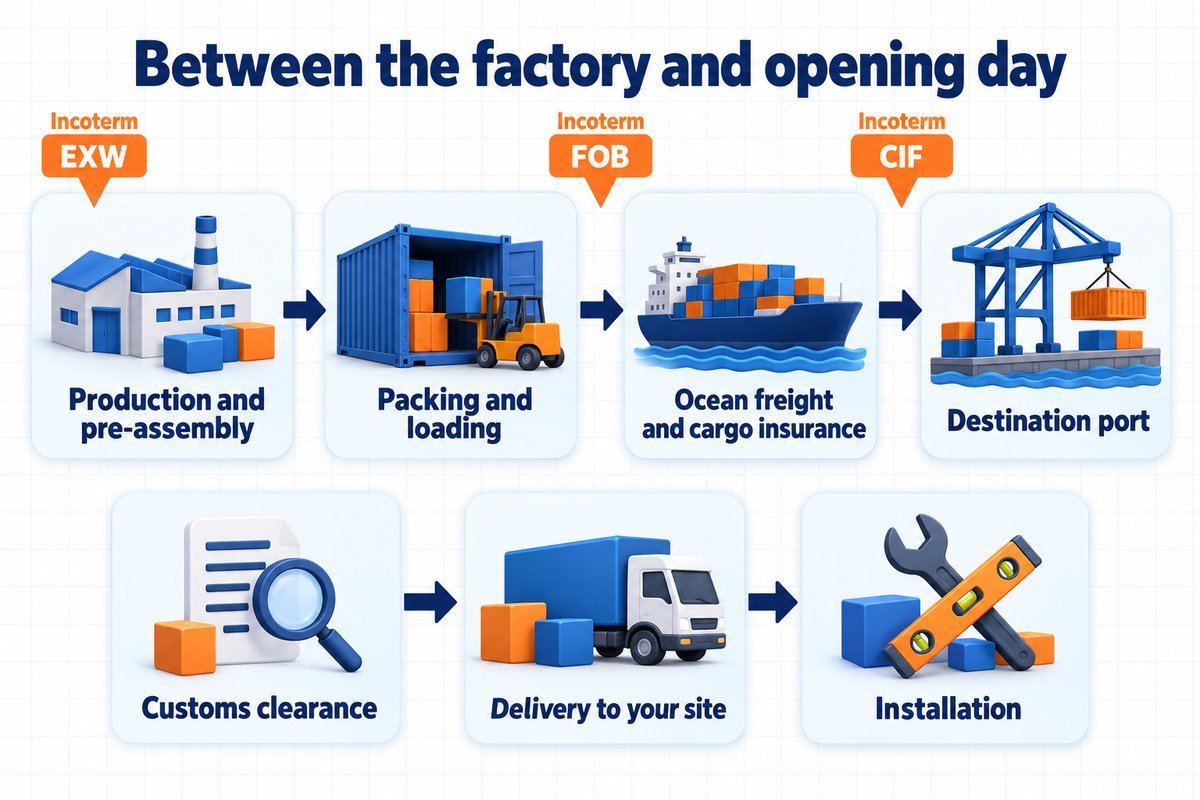
Between the factory and opening day, the equipment goes through these stages:
- Production and pre-assembly at the factory
- Packing and loading into containers
- Ocean freight and cargo insurance
- Charges at the destination port
- Customs clearance, import duty and import VAT or sales tax
- Delivery to your site and unloading
- Installation
The trade term (Incoterm) in the quote tells you who pays at each stage. The International Chamber of Commerce publishes 11 Incoterms rules, and its 2020 version sets out the costs under each rule in one place. Three common ones are:
- EXW (Ex Works): you take over at the factory and pay for everything after that.
- FOB (Free on Board): the supplier pays to get the goods loaded onto the ship at the port of shipment. You pay the ocean freight and everything after it.
- CIF (Cost, Insurance and Freight): the supplier pays the freight and insurance to your destination port. Import duties and delivery to your site are still yours. Under CIF, the default insurance is the minimum level of cover, so ask for more if you need it.
For freight, give a freight forwarder the number and size of containers on the supplier’s packing list. Ask for a quote to your nearest port and then on to the site. For import duty, have the supplier put the tariff code on the quote, then ask a licensed customs broker to estimate the duty and tax. In the UK, the customs declaration requires a commodity code, and the UK Trade Tariff shows the duty and VAT attached to it. We do not quote a duty rate here because it depends on the code and can change with trade policy.
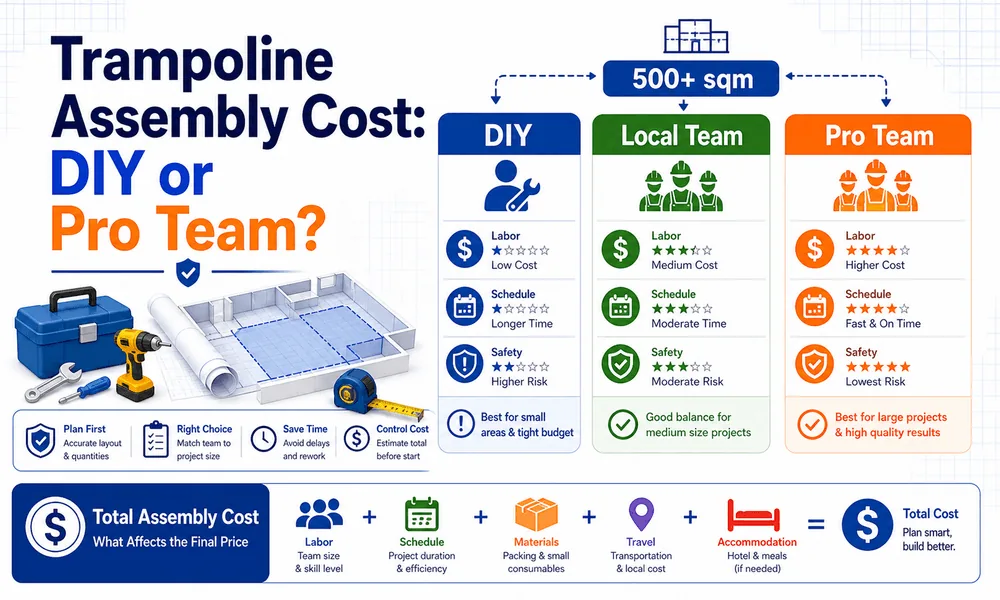
Installation is charged per installer, per day. As of October 2026, the rate for our installers is $150 per person for an 8-hour day. You arrange and pay for the team’s flights, accommodation and meals, and we handle their visas. There is no geographic limit. For larger projects, we usually send one or more of our installers to lead the work, with local workers hired by you to help. For other projects, we send our own team of engineers. The approach depends on the size of the park. For your budget, multiply the number of installers by the number of days on site and then by the daily rate. Add travel and accommodation afterward. Installation takes about 5 days for a small park (about 100 square meters, or 1,076 square feet, of equipment), 10 days for a medium park (about 300 square meters, or 3,229 square feet, of equipment) and 40 days for a large one (about 2,000 square meters, or 21,528 square feet, of equipment). Also confirm who supplies local workers, a forklift or lift and any scaffolding, as these are often outside an installer’s price. To work out when to send our installers and how much to budget for them, see trampoline park installation costs.
Building, Fit-Out and Permits
The building is the part of a first budget most likely to grow. The equipment price is fixed once the design is final, but you will not know the fit-out cost until you have chosen a building and had it inspected.
In the two franchise tables we found that give a line-by-line breakdown, building work is one of the two largest costs. Urban Air’s 2026 disclosure lists leasehold improvements at $853,613 to $2,225,980 for its 2.0 format. At the high end, that is more than its base attraction equipment package. These are large franchise buildings. The amounts are smaller for a smaller park, but the basic rule is the same: the more work the building needs, the more budget it will take.
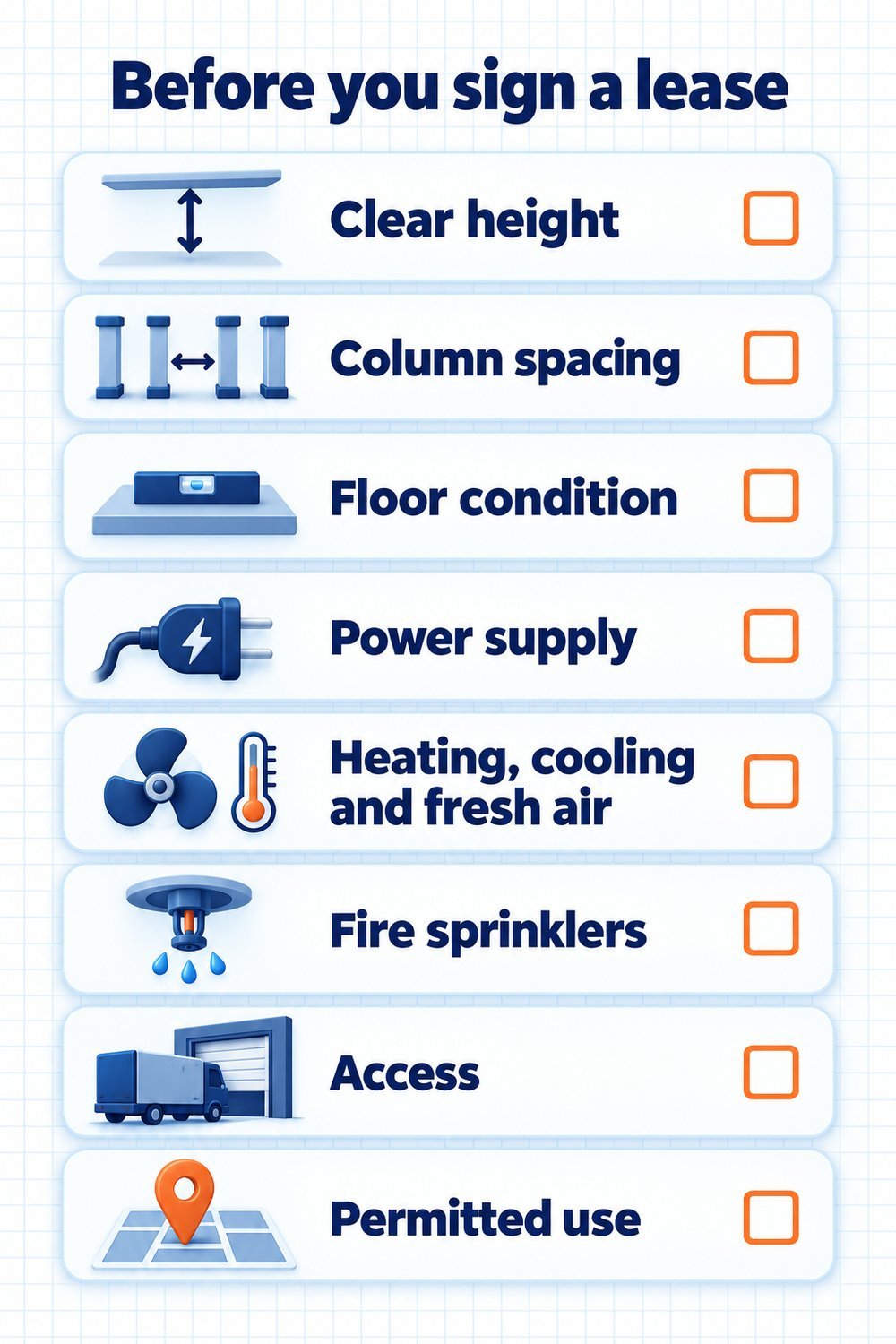
Check these before you sign a lease, because each one can add building work:
- Clear height above every zone, measured to the lowest obstruction
- Column spacing, which decides where courts and walls can go
- Floor condition, including how level it is and what load it can take
- Power supply for lighting, sound, games and the café
- Heating, cooling and fresh air, since jumpers generate a lot of heat
- Fire sprinklers, which may need moving if the equipment blocks them
- Access for unloading the containers and moving long frames inside
- Permitted use, which your local planning or zoning office must confirm
Before committing to the building, get a contractor’s estimate for every item that needs work and leave a contingency in this part of the budget. Our site measurement guide shows how to measure the clear height and column positions before you ask for a layout.
The Cost of Waiting: Rent and Wages Before Opening
Time is the other cost that can grow quietly. If the lease begins before the park opens, rent is due before you have ticket sales. Once you hire staff, wages start as well.
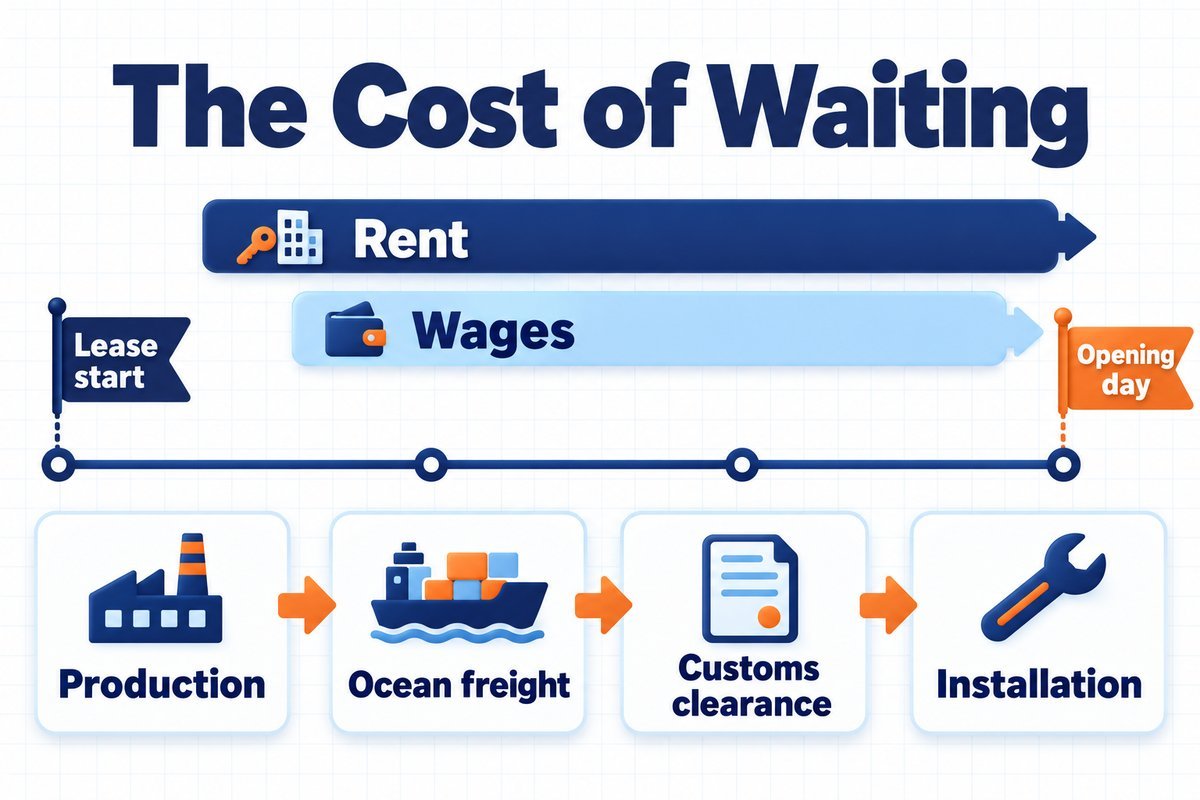
From the day we receive your deposit through the end of installation, the equipment takes at least 68 days for a small park, 83 days for a medium park and 148 days for a large one. You also need to allow time for pre-assembly and container loading. Those totals combine our production time, 45 days of ocean freight, 3 days for customs clearance and the installation time listed above. The freight and customs timings are planning figures and can change depending on the port and inland delivery. From August to October, allow about 10 days more for production.
Two ways to keep this cost down:
- Negotiate a rent-free fit-out period, or a lease start date close to your planned installation date.
- Run the building work, permits and hiring while the equipment is being made and shipped, so the building is ready when the installation team arrives.
To budget for this period, multiply the months from the lease start to the opening date by the monthly rent. Then add wages from the date you begin hiring staff.
Most of these costs continue after opening: rent, staff, liability and property insurance, utilities, maintenance and inspections, marketing, and booking or waiver software. We did not find reliable public figures for most of them because the costs depend on the building and location. Get local prices for each one before signing the lease.
Build Your Budget in Three Layers
A practical way to build the budget is to split it into three layers: the costs you can quote early, the costs you will know only after choosing a building, and the costs that keep running while you wait. Lock down the first layer, keep a contingency for the second and calculate the third month by month.
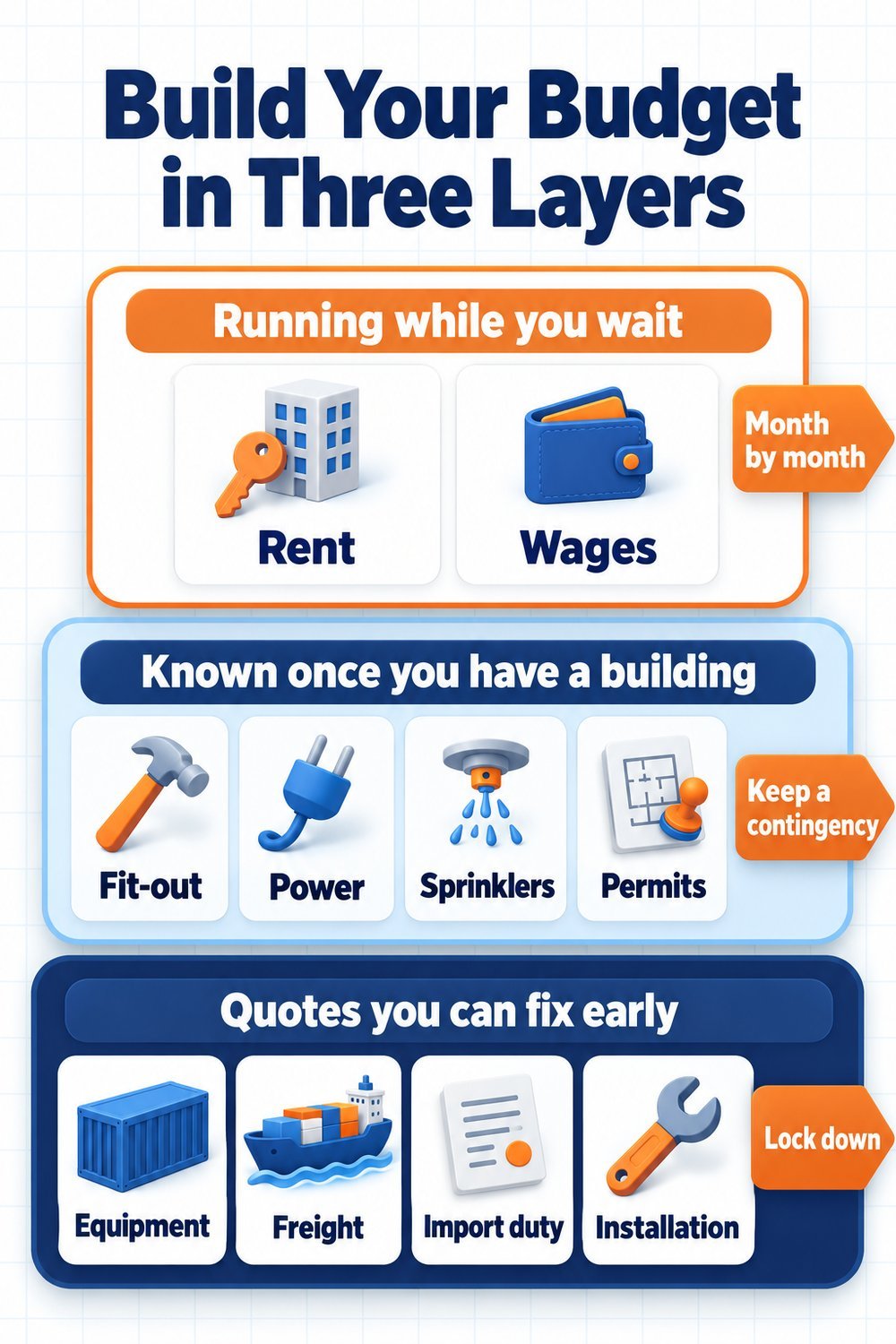
Here is what that looks like for a 1,500 square meter (16,146 square foot) independent park.
| Layer | Item | How to get the figure | Example (1,500 square meters / 16,146 square feet) |
|---|---|---|---|
| 1. Quotes you can fix early | Equipment | Our quick estimate, then a firm quote after the final design | About $180,000 (FOB) |
| Freight, insurance and port charges | A freight forwarder’s quote for the containers on the packing list | Get a quote | |
| Import duty and tax | The tariff code on the quote, and a customs broker’s estimate | Get an estimate | |
| Installation | Installers × days × $150, plus their flights, accommodation and meals | Ask for the crew size and days | |
| 2. Known once you have a building | Fit-out, power, heating and cooling, sprinklers, permits | A contractor’s estimate after inspecting the building | Get estimates, then add a contingency |
| 3. Running while you wait | Rent, wages and insurance before opening | Months from lease start to opening × monthly cost | Depends on your lease |
Once you have filled in all three layers, compare the total with the rule of thumb. For a park this size, equipment makes up about a third of the total, pointing to roughly $500,000 to $600,000. If your total is much lower, check for missing freight, import duty, installation or building work. These are the costs people most often leave out.
Franchise vs Independent: The Cost Difference
A franchise comes with an initial fee, ongoing fees on sales and minimum financial requirements. Franchise formats also have much bigger budgets than most first independent parks. Even so, their disclosure documents are useful because they show where the money goes in a large park, line by line.
| Urban Air | Sky Zone | Launch Entertainment | |
|---|---|---|---|
| Initial franchise fee | $100,000 | $75,000 | $75,000 |
| Ongoing fees | 7% royalty and 6% local marketing, on gross sales | 6% royalty; $12,000 local advertising in the first month, then 4%; technology fee of $1,480 a month | 6% royalty and 2% brand marketing, on gross sales |
| Estimated initial investment | $2,852,887 – $5,441,558 (2.0 park) · $4,147,074 – $7,944,050 (2.5 park) | $2,330,960 – $5,175,460 | $3,517,213 – $6,501,900 |
| Financial requirements | $1.5 million net worth and $750,000 in liquid assets | Minimum $500,000 in cash, on its franchise inquiry form | Not published on the page we checked |
| Source | 2026 FDD, on the brand’s investment page | 2025 FDD, as compiled by a franchise directory | FDD Items 6 and 7, quoted on the brand’s franchise page |
We checked these pages on 6 October 2026, apart from Sky Zone’s franchise inquiry form, which we checked on 29 September 2026. Franchise figures change whenever a franchise disclosure document (FDD) is reissued.
Launch’s figure covers a multi-attraction family entertainment center (FEC), rather than trampolines alone. Two entries in Urban Air’s table are useful for an independent budget. The base attraction equipment package is $1,214,760 to $1,618,650, and the budget includes $150,000 to $270,000 in working capital for the first months. An independent park avoids the franchise fee and royalties, but it still has the same types of expenses: the lease, building work, attractions, insurance, wages and enough cash to carry the park until attendance settles. Cost is only one part of deciding whether a franchise fits. Our guide to choosing between franchise or independent explains the other trade-offs.
How to Get a Comparable Quote
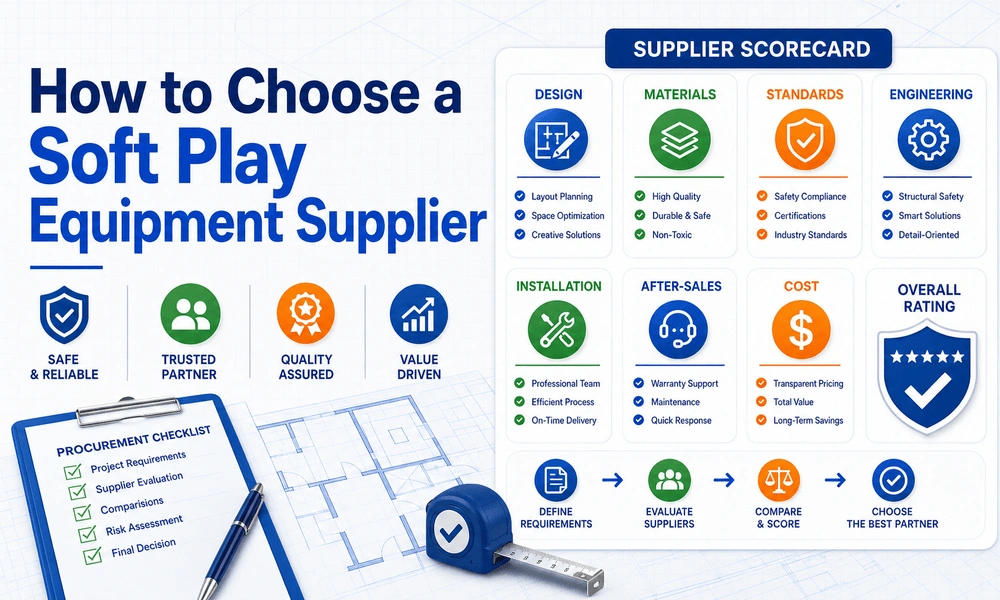
Two equipment quotes are comparable only if they cover the same scope. One can look cheaper simply because it excludes freight, soft parts or installation, or uses a smaller area for the price. Put the same questions to every supplier.
| What to check | What to ask | Why it changes your total |
|---|---|---|
| Price basis | Is it a turnkey price that includes installation, a price for the equipment only, a price per zone, or a price per square meter or square foot? If per area, which area? | Prices per area cannot be compared unless they use the same area |
| Zones and items | Which zones, and which parts of each zone, are included? | A quote can look cheaper because a zone or part is missing |
| Soft parts | Are padding, safety netting, foam blocks and floor mats included, and in what quantity? | These are easy to leave out, and adding them later means a second order and shipment |
| Design | Are the layout drawings and revisions included? | Changes after ordering can be charged separately |
| Pre-assembly | What is assembled or checked at the factory before shipping? | Problems found on site cost installation days |
| Packing | How many containers, and of what size? | Full-container freight is priced per container |
| Trade term | Which Incoterm (EXW, FOB, CIF or another)? Where does the supplier’s responsibility end? | Under EXW or FOB, you pay the ocean freight yourself |
| Freight and insurance | Are ocean freight and cargo insurance included? What level of insurance cover? | CIF includes only the minimum insurance cover by default |
| Import duty | What tariff code does the supplier use for the equipment? | Duty and import VAT or sales tax are calculated from it |
| Delivery to site | Who pays for port charges, customs clearance, inland delivery and unloading? | Under EXW, FOB and CIF, most of these are your costs |
| Installation | How many installers, for how many days, at what daily rate? Who pays their flights, accommodation and meals? Who handles visas? Who provides local workers and lifting equipment? | Travel and local labor can sit outside the daily rate |
| Spare parts | Which spare springs, mats and pads are included? | Wear parts need replacing over time, and spares on site avoid closing a court while you wait |
| Safety standard | Which standard is the equipment built to (for trampoline parks, ASTM F2970 in the United States or EN ISO 23659 in Europe), and which documents will you receive? | Your insurer and local authority may ask for them |
| Production time | Is it counted in calendar days from your deposit or in working days from drawing approval? | A later opening date means more rent before any income |
| Payment and inspection | When is each payment due? Can you send an inspector to the factory before shipping? | Payment timing affects your cash flow; inspection protects the balance payment |
| Warranty | What is covered, for how long, and who pays to ship replacement parts? | Shipping replacement parts across an ocean costs time as well as money |
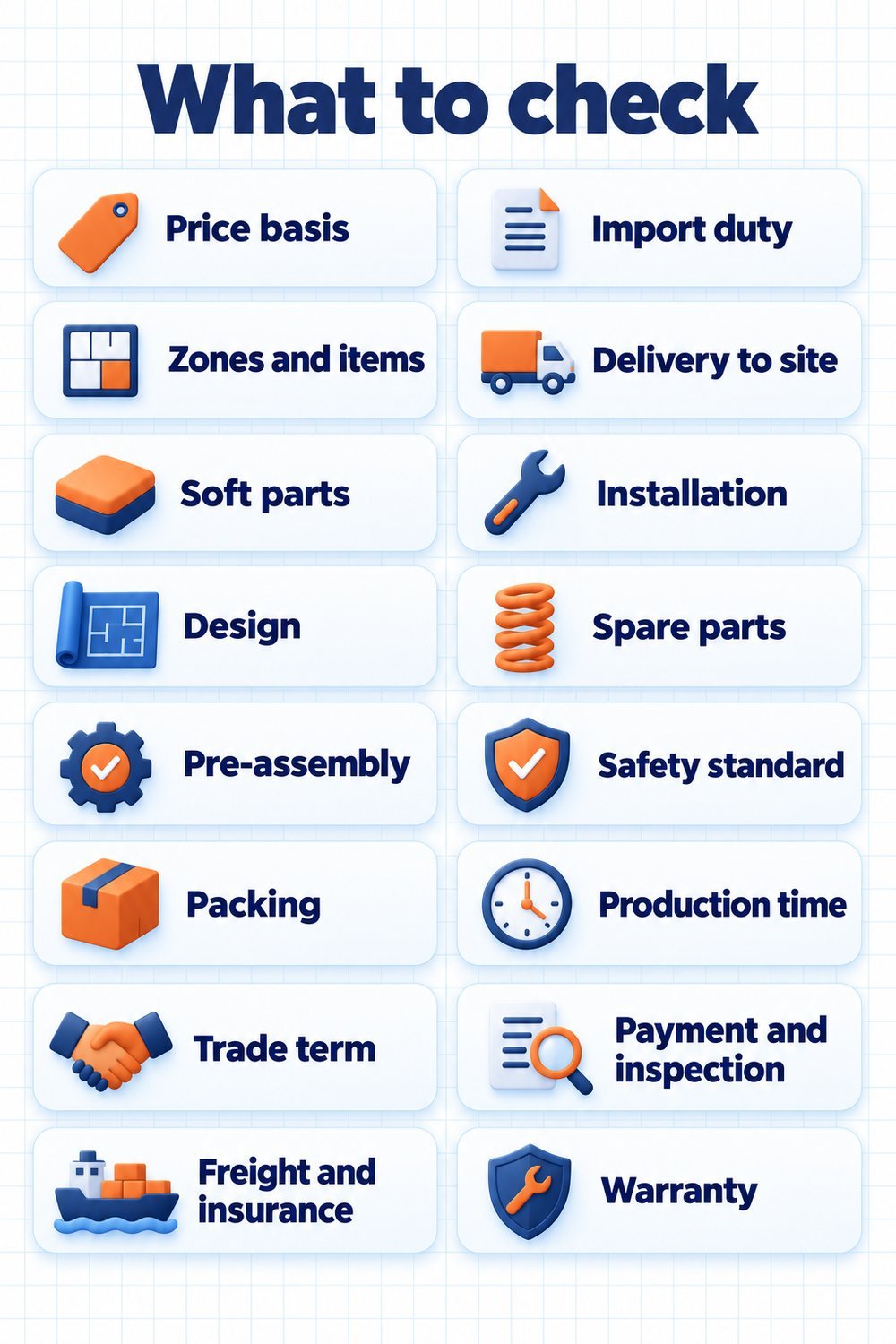
Our quotes show each stage separately. The quick estimate is per square meter of floor area, FOB, with the firm quote issued after the final design rendering. Production begins when we receive a 30% deposit, and the 70% balance is paid by TT before shipping. You may send a third-party inspector to our factory before the equipment ships. We work with EXW, FOB, CIF and the other common Incoterms.
For a quote you can compare properly, give each supplier the same floor plan, clear height, column positions, zone list and target opening date. You can send these to us through our contact page.
Frequently Asked Questions
How much does it cost to set up a trampoline park in the UK?
Use the same budget layers. Our equipment estimate uses the same FOB price wherever the park is, and the installation terms have no geographic limit. The building cost, local wages and import charges will change. Equipment coming from outside the UK may be subject to import duty and VAT, depending on its commodity code. In England and Wales, include business rates for the building; Scotland and Northern Ireland use their own systems. The franchise figures above cover parks in the United States, so do not use them as a guide to UK costs.
How profitable is a trampoline park business?
We have not found public profit or payback figures we could verify, and we do not provide one ourselves. Your profit will depend on the rent, ticket and party prices, and how busy the park stays on weekdays. Build the forecast in your business plan using the three budget layers above. Put your own lease, local wages and real quotes on the cost side, then use local prices and a realistic weekday attendance estimate on the income side.
How much does trampoline park equipment cost per square foot?
Our quick estimate of about $120 per square meter of floor area is about $11 per square foot, FOB. Other manufacturers publish a much wider range, from about $9 to $200 per square foot, partly because they use different areas for the calculation. Some quote per square foot of jumping surface only, which produces a much higher figure than spreading the price across the whole floor. Before comparing prices, ask which area each one uses.
Sources
- Urban Air Adventure Park, Investment, quoting items 6 and 7 of its 2026 Franchise Disclosure Document. urbanairfranchise.com/investment/. Accessed 6 October 2026.
- Franchise Direct, Sky Zone Indoor Trampoline Park Franchise Costs, Fees & FDD, compiled from Sky Zone’s 2025 FDD. franchisedirect.com. Accessed 6 October 2026.
- Launch Entertainment, Franchise, quoting items 6 and 7 of its Franchise Disclosure Document. launchfamilyentertainment.com/franchise/. Accessed 6 October 2026.
- Sky Zone, Franchise. skyzone.com/franchise/. Accessed 29 September 2026.
- International Chamber of Commerce, Incoterms® 2020. iccwbo.org. Accessed 6 October 2026.
- GOV.UK, Trade Tariff: look up commodity codes, duty and VAT rates. gov.uk/trade-tariff. Accessed 6 October 2026.
- GOV.UK, Business rates. gov.uk/introduction-to-business-rates. Accessed 6 October 2026.